
Understanding What Foreigners Can Own, Use and Hold Under Thai Law
Thailand remains an attractive destination for foreign buyers seeking a home, a second residence or a long-term property investment. However, the legal framework governing foreign ownership is different from that in many other jurisdictions.
The key point is that Thai law does not treat all property rights in the same way.
While foreign ownership of land is generally restricted, foreigners may still acquire ownership of certain types of property and may hold various legally recognised rights over land and buildings.
Understanding these different forms of property rights is therefore an important first step before entering into any property transaction in Thailand.
Land Ownership : The Main Restriction
The most significant restriction concerns ownership of land.
Under the Thai Law, foreigners are generally not permitted to own land in Thailand. There are limited statutory exceptions, but these are subject to specific conditions and government approval and should not be regarded as a general right for foreign buyers. For example, Section 96 bis provides a limited route for qualifying foreigners who make the required investment in Thailand to acquire up to one rai of land for residential purposes, subject to the statutory conditions.
For most foreign buyers, therefore, the practical question is not simply whether they can “buy property”, but what type of legal interest they can lawfully acquire in that property.
This distinction becomes particularly important when considering houses and villas. A foreigner may generally not own the land on which a villa stands, but the legal rights relating to the building, possession and use of the property may be structured separately from ownership of the land. This is why a property transaction involving a foreign buyer should always distinguish between land ownership and other property rights.
Condominium Ownership: The Main Form of Direct Ownership
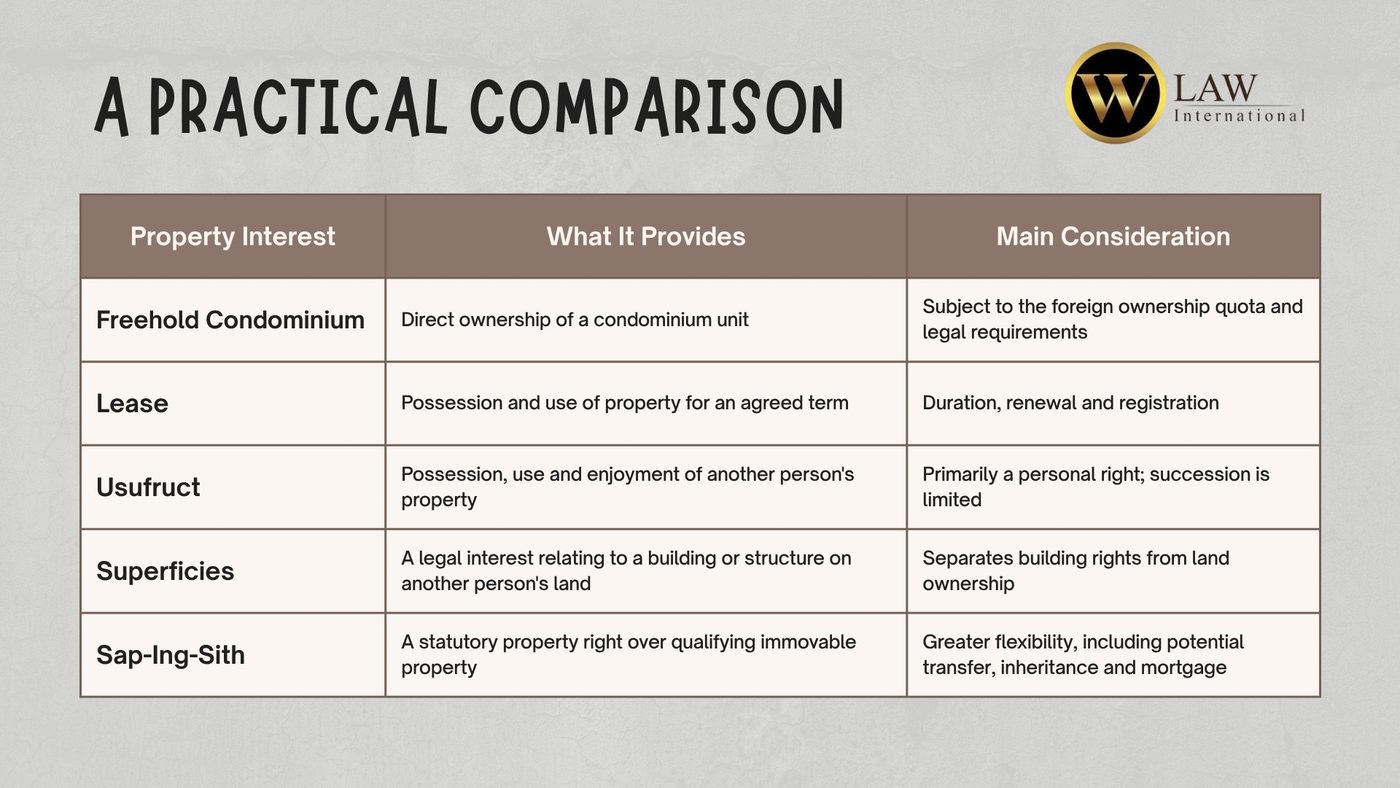
One of the clearest forms of property ownership available to foreigners in Thailand is freehold ownership of a condominium unit. Subject to the requirements of the Condominium Act, a qualifying foreigner may register a condominium unit in their own name and hold direct ownership of that unit.
However, foreign ownership is subject to the 49% foreign ownership quota. In general, the total area of condominium units owned by foreigners in a condominium cannot exceed 49% of the total area of all units in that condominium.
The availability of foreign quota is therefore an important consideration before a purchase is completed.
Where the relevant requirements are satisfied and sufficient foreign quota is available, a foreign purchaser can hold freehold title to the condominium unit itself. This is fundamentally different from a lease, where the purchaser receives a right to use and possess the property for a specified period rather than ownership of the property.
Rights Over Land Without Owning the Land
The restriction on foreign land ownership does not prevent foreigners from having legally recognised interests in land. Thai law provides several forms of rights that can allow a person to possess, use or enjoy property belonging to someone else. These rights can be particularly relevant to foreign buyers seeking to acquire or use a house, villa or other property where direct ownership of the underlying land is not available.
Lease
- A lease provides a right to possess and use property for an agreed period.
- For an immovable property lease exceeding three years, registration is required for the lease to be enforceable beyond three years. The ordinary statutory maximum term for a lease is generally 30 years per term.
- Leasehold arrangements are commonly used by foreigners seeking long-term use of land, houses and villas without acquiring ownership of the land.
Usufruct
- A usufruct gives the holder the right to possess, use and enjoy the benefits of property belonging to another person.
- It can be useful where the primary objective is personal or lifetime use of a property rather than creating a transferable investment asset.
Superficies
- A right of superficies allows rights relating to a building or structure to be separated from ownership of the underlying land.
- This can be particularly relevant where a foreigner wishes to build or have an interest in a house or villa situated on land owned by another person.
Sap-Ing-Sith
- Sap-Ing-Sith is a specific property right established under Thai law. It differs from an ordinary lease and provides a more structured legal interest in qualifying immovable property.
- Among its notable characteristics, the right may, subject to the applicable legal requirements, be transferred, inherited and mortgaged.
These forms of property rights have different legal characteristics and should not be treated as interchangeable. Their duration, registration, renewal, transferability and succession can differ considerably.
Registration Matters
As a general principle under Thai law, rights in immovable property must be registered with the competent Land Office in order to be legally effective and binding in full against the relevant parties and third parties, where required by law.
This applies not only to the transfer of ownership, but also to various other rights in immovable property, including registered leases, usufruct, superficies and Sap-Ing-Sith.
Registration creates an official record of the relevant right against the property and provides an important layer of legal certainty and protection to the rights holder.
Accordingly, when acquiring or structuring any interest in immovable property in Thailand, it is important to consider not only the terms of the underlying agreement, but also whether the relevant right must be registered and what legal effect registration has under Thai law.
What Foreign Buyers Should Consider
The most suitable property structure depends on the purpose of the investment.
A foreign buyer seeking direct ownership may consider a freehold condominium, provided the applicable requirements and foreign quota are satisfied. Someone primarily seeking long-term occupation of a villa or house may consider a lease. Where the objective is personal or lifetime enjoyment, usufruct may be more appropriate. Where the buyer wishes to establish rights relating to a building on land owned by another person, superficies may be relevant. For those seeking a more flexible property interest, Sap-Ing-Sith may provide another option, particularly where transfer, inheritance or financing is important.
The important consideration is therefore not simply the length of time for which the property can be used. It is the nature of the right itself and what that right allows the holder to do during and at the end of the arrangement.
Understanding Your Property Rights Before You Buy
For a foreign buyer, the question should not simply be whether a particular property can be purchased. The more important question is:
What legal right will I actually hold after the transaction?
Ownership of land, ownership of a condominium unit, a lease, usufruct, superficies and Sap-Ing-Sith are fundamentally different legal interests. Each provides a different level and type of control, protection and flexibility.
A properly structured property transaction should therefore consider the nature of the property, the intended use, duration, registration requirements, renewal, transfer, inheritance and long-term objectives from the outset.
For foreigners investing in Thai real estate, understanding these distinctions is the first step toward acquiring a property interest that is legally valid, properly registered and aligned with their long-term objectives.
*** This article is intended for general informational purposes only and does not constitute legal advice. The availability and legal effect of each property right depend on the specific circumstances, property and applicable Thai laws and regulations. Foreign buyers should obtain specific legal advice before entering into a property transaction in Thailand.
Call 020556212
Email : contact@w-lawthai.com
Line @wlaw
W Law and Real Estate International (Thailand) Co., Ltd.
- Bangkok Office: 518/3 4th Floor, Maneeya Center North Building, Ploenchit Road, Lumpini, Pathumwan, Bangkok Metropolis 10330
- Phuket Office: 63/202 Moo 2 Royal Phuket Marina, Thepkasattri Road, Kohkaew, Muang Phuket, Phuket Province 83000
- Pattaya Office: 666/66 Level 3 Conventional Hall Brighton Grand Hotel Pattaya, Moo 5, Naklua, Banglamung, Chonburi Province 20150
